

Liquid crystals (LCs) represent a recognized state of matter utilized in everyday technology, particularly in display devices such as televisions. The uniqueness of LCs is reflected in their name, which highlights characteristic properties inherited from both solids and liquids. Thus, they maintain a degree of molecular ordering while exhibiting high inter- and intramolecular mobility and are referred to as mesomorphic systems or mesophases [1].
LCs can be divided into two subgroups: thermotropic and lyotropic liquid crystals Dağ Group specializes in lyotropic liquid crystals (LLCs), which include at least two critical components: a solvent and a surfactant. Surface-active reagents, or surfactants, possess both hydrophobic (tail) and hydrophilic (head) groups, resulting in a solubility gradient within a single molecule. However, although certain surfactants dissolve in polar or apolar solvents, the resultant solution consists of just amphiphiles solvated by the solvent molecules. LLC mesophases are formed through the self-assembly of those surfactant molecules, which aggregate to form micelles upon exceeding a critical micelle concentration (CMC) [1] [2]. The nature of the aggregation process, the choice of solvent and/or surfactant, and the shape of the micelles can lead to various LLC mesophases, mainly forming anisotropic features (birefringence) under optical microscopy. Figure 1a is a typical example of a hexagonal LLC phase.
Dağ Group discovered in 2001 that solutions containing solvents, surfactants, and certain transition metal nitrate salts result in LLC mesophases [1]. It is important to note that binary systems of surfactants and solvents cannot hold salt species within their structure.
Further studies showed that the transition metal salts in these solutions remain in the molten phase even at high mole ratios. They do not nucleate as salt crystals within the liquid crystal phase due to the soft confinement effect, thus forming a stable mesophase [3].
Another valuable study in this field demonstrates the depression of the melting temperature of the salt species confined within the micelles to as low as -52°C, without crystallizing above this temperature [1] [2]. This phenomenon extends to salt-surfactant systems utilizing both ionic and non-ionic surfactants.
Recent studies explore the formation of lyotropic liquid crystalline mesophases containing more than two transition metal nitrate salts. This stabilizes the mesophase and subsequently impacts the synthesis of mesoporous materials and thin films [3] [4].
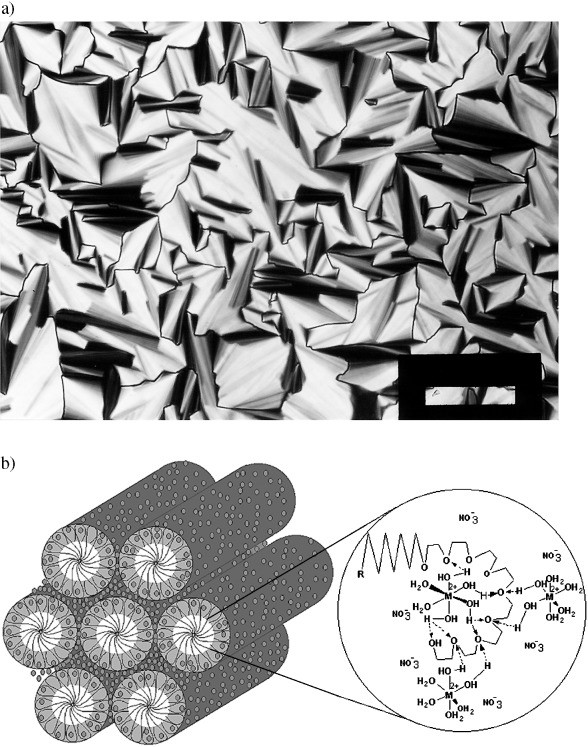
Figure 1. a) A representative POM image of [Cd(H2O)4](NO3)2 in C12H25(CH2CH2O)10OH with a MX2/No mole ratio of 2.0/1 (the scale bar is 200 μm). b) A schematic representation of a hexagonal LC MX2/No structure, the small circles represent [M(H2O)n]2+ and NO3− ions.
References
[1] Çelik, Ö.; Dag, Ö. Lyotropic Liquid Crystalline Phases of Transition-Metal Salts and Nonionic Surfactants. Angew. Chem., Int. Ed. 2001, 40 (20), 3799–3803.
[2] Uysal, İ.; Dag, Ö. Effects of Ions on the Liquid Crystalline Mesophase of Transition-Metal Salt:Surfactant (CnEOm). J. Phys. Chem. B 2004, 108 (24), 8439–8446.
[3] Dag, Ö.; Samarskaya, O.; Tura, C.; Günay, A.; Çelik, Ö. Lyotropic Liquid-Crystalline Phase of Oligo(ethylene oxide) Surfactant/Transition Metal Salt and the Synthesis of Mesostructured Cadmium Sulfide. Chem. Mater. 2003, 15 (14), 2711–2717.
[4] Poyraz, A. S.; Dag, Ö. Role of Organic and Inorganic Additives on the Assembly of CTAB-P123 and the Morphology of Mesoporous Silica Particles. J. Phys. Chem. C 2009, 113 (43), 18596–18607.