
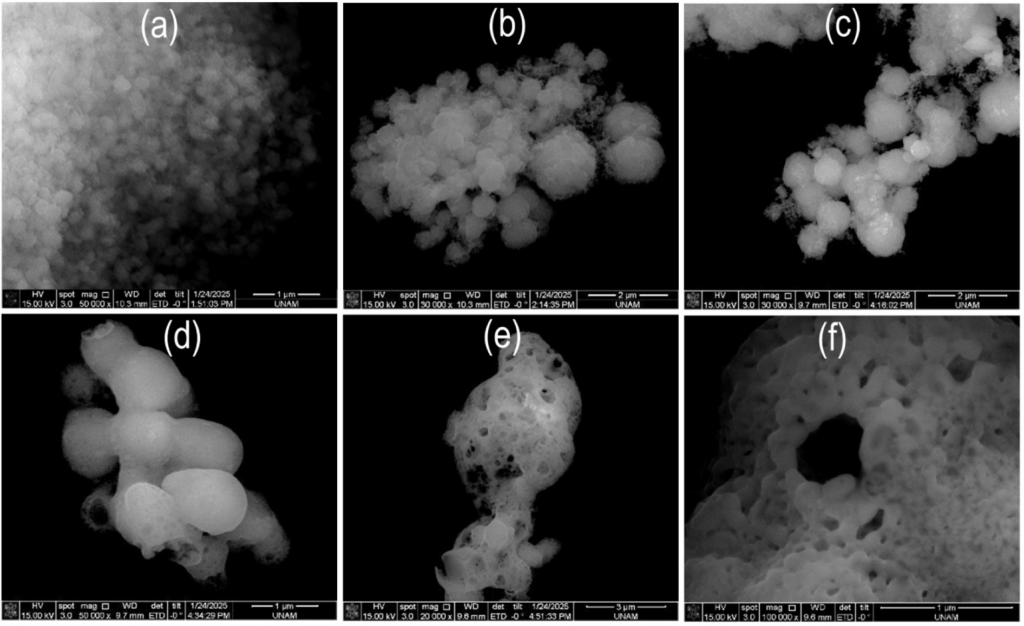
Mesoporous materials are defined by IUPAC as having pore sizes between 2 and 50 nm. These materials can be synthesized via either hard or soft templating methods. Dağ Group employs soft templating to synthesize mesoporous materials using surface-active reagents, or surfactants. This process involves the formation of a lyotropic liquid crystalline (LLC) mesophase through the aggregation of surfactant molecules into micelles, followed by their self-assembly. The mesophase is then calcined at elevated temperatures to combust the surfactants, leaving behind voids that form the pores [1].
A crucial contribution of the Dağ Group to the development of mesoporous materials is the Molten Salt Assisted Self-Assembly (MASA) method, which they introduced to the literature in 2011 [1]. The MASA method was first applied to hydrated Zn(II) and Cd(II) nitrate salts as inorganic species in a medium containing alcohol-based solvents, alongside C12EO10 (non-ionic) and CTAB (ionic) surfactants [2].
The MASA method demonstrated that mesoporous silica-metal oxide thin films can be synthesized by calcining mesophases consisting of salt species confined in their molten phase between the silica and surfactant domains [2, Figure 1].ü
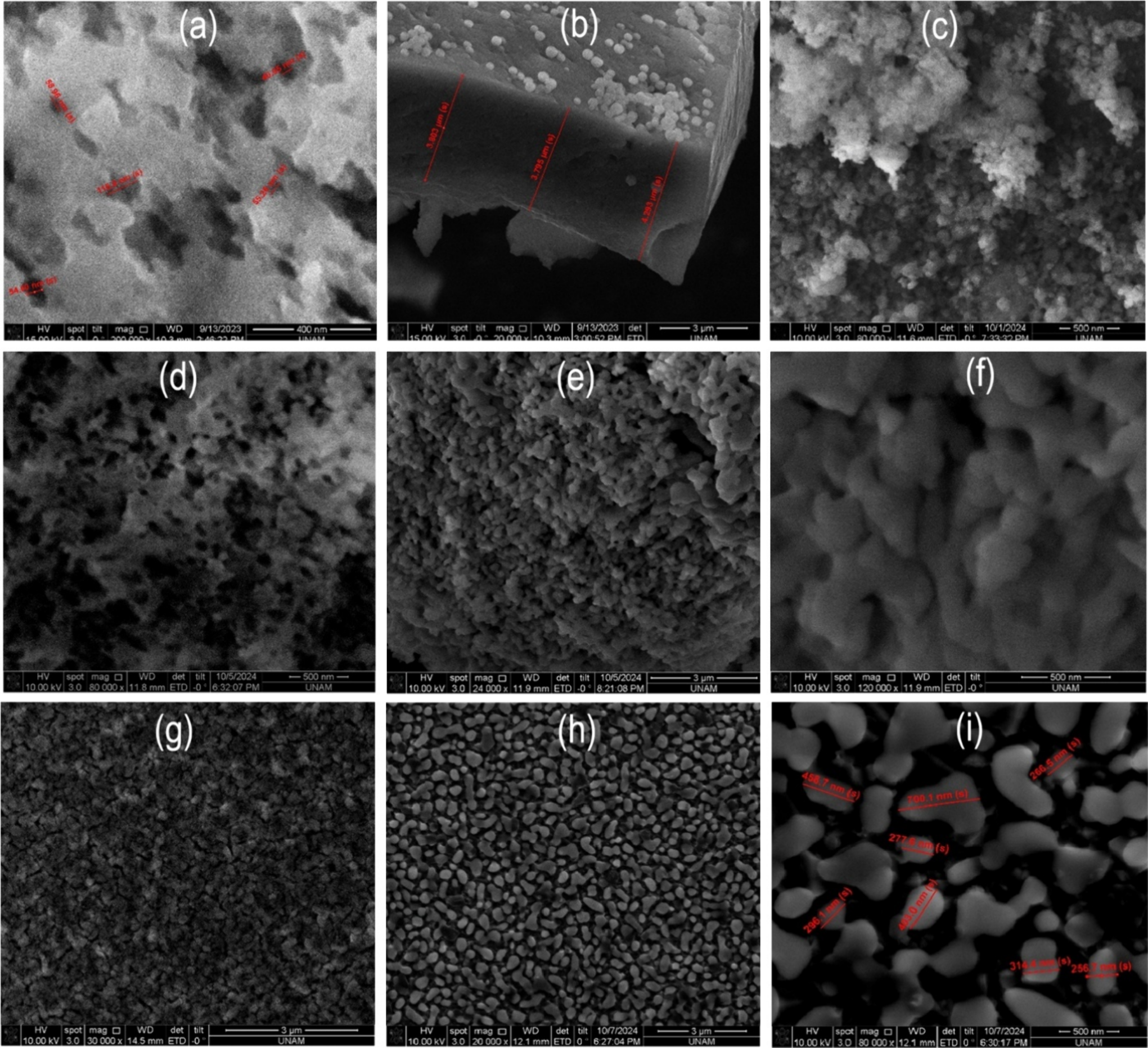
Figure 1. SEM images of the ethanol precipitate Ni2P2O7 at (a,b) RT (scale bars 400 nm and 3 μm), (c) 300 (scale bar 500 nm), (d) 500 (scale bar 500 nm), (e) 700 (scale bar 3 μm), and (f) 700 °C (scale bar 500 nm). FTO coated supernatant, calcined at (g) 300 (scale bar 3 μm) and (h,i) 700 °C (scale bar 3 mm and 500 nm).
The MASA method was applied to fabricate thin films and monoliths of mesoporous metal titanates (CoTiO3, MnTiO3, and Li4Ti5O12) [3]. Using this method, these mesophases can also be coated onto fluorine-doped tin oxide (FTO) glass and graphite rods (GR). The coated substrates are subsequently annealed at temperatures ranging from 300 °C to 700 °C to yield mesoporous thin-film electrodes [4] [5].
References
[1] Çelik, Ö.; Dag, Ö. Lyotropic Liquid Crystalline Phases of Transition-Metal Salts and Nonionic Surfactants. Angew. Chem., Int. Ed. 2001, 40 (20), 3799–3803.
[2] Karakaya, C., Türker, Y., Albayrak, C., & Dag, Ö. Assembly of Molten Transition Metal Salt–Surfactant in a Confined Space for the Synthesis of Mesoporous Metal Oxide-Rich Metal Oxide–Silica Thin Films. Chemistry of Materials, 2011, 23, 3062–3071.
[3] Karakaya, C.; Türker, Y.; Dag, Ö. Molten-Salt-Assisted Self-Assembly (MASA)-Synthesis of Mesoporous Metal Titanate-Titania, Metal Sulfide-Titania, and Metal Selenide-Titania Thin Films. Adv. Funct. Mater. 2013, 23 (32), 4002–4010.
[4] Karakaya Durukan, I.; Dag, Ö. Electronic Synergistic Effects on the Stability and Oxygen Evolution Reaction Efficiency of the Mesoporous LiMn2–xMxO4 (M = Mn, Fe, Co, Ni, and Cu) Electrodes. Inorg. Chem. 2024, 63 (46), 22239–22257.
[5] Katırcı, A. A.; Karakaya Durukan, I.; Dag, Ö. Nanoarchitectonic Mesoporous Ni1–xMnxO Electrodes: Charge Capacity and Oxygen Evolution Reaction Electrocatalysis in Alkaline Media. ACS Appl. Energy Mater. 2025, 8 (5), 3162–3177.