We congratulate our alumni Gözde Ceran, Sara Samuei, and Irmak Karakaya Durukan for their newest ACS Inorganic Chemistry article “Alcohol-Mediated Self-Assembly of Mesoporous Mn2–xMxP2O7 (M = Ni, Co) via Sol–Gel Chemistry: Reconstruction into Mixed Mn1–yMy(OH)2 and Enhanced Alkaline OER Activity and Stability“!1
The article’s abstract as follows:
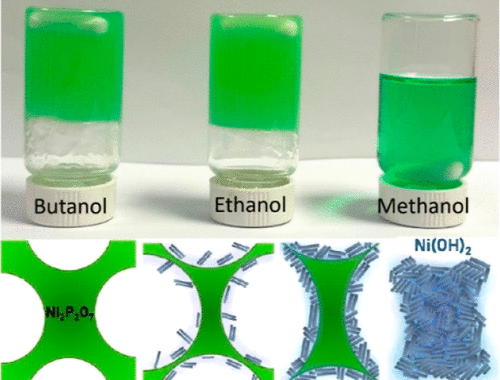
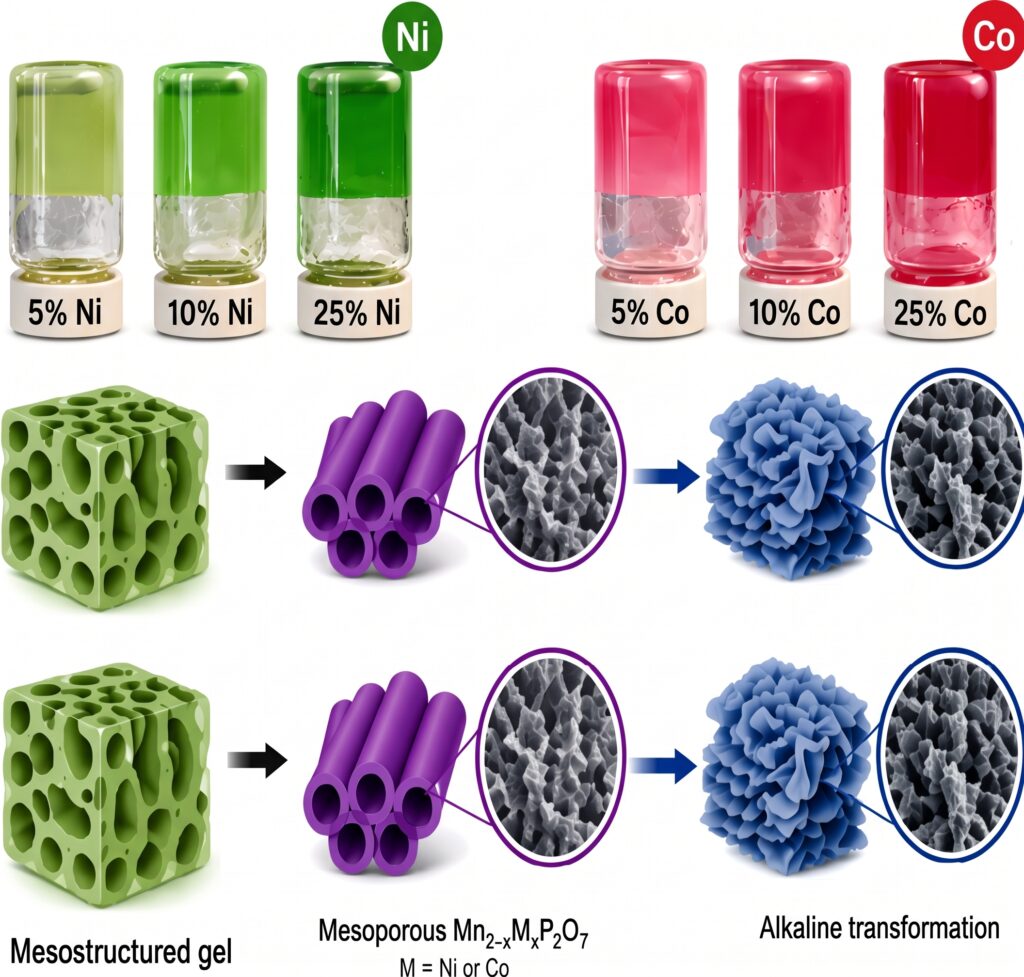
The effect of solvent on the soft-templated synthesis of manganese-rich mesoporous Mn2–xMxP2O7 (M = Ni or Co; x = 0.14, 0.27, and 0.64) is systematically investigated using methanol, ethanol, and 1-butanol. Ethanol and 1-butanol solutions undergo rapid gelation via a sol–gel pathway, yielding high-surface-area mesoporous materials after calcination, whereas methanol solutions favor precipitation but still produce mesoporous structures upon coating, drying, and calcination. Both gel/precipitate fractions and whole solutions of the initial ingredient mixtures can be processed into homogeneous thin films on graphite rods via dip-coating and calcination. The resulting electrodes, calcined at various temperatures, are evaluated for the alkaline oxygen evolution reaction (OER) in 1 M KOH. Upon immersion, the pyrophosphate phases rapidly transform into their corresponding metal hydroxides, which act as the active catalytic phase. Incorporation of Ni(II) or Co(II) into manganese-based systems enhances electrode stability and catalytic performance, delivering low overpotentials (down to 230 mV at 1 mA cm–2) and small Tafel slopes (as low as 38.9 mV dec–1). These results highlight the critical role of solvent-controlled assembly and composition in tailoring mesostructure, transformation behavior, and OER activity.
1Ceran, G.; Samuei, S.; Durukan, I. K.; Dağ, Ö. Alcohol-Mediated Self-Assembly of Mesoporous Mn2–xMxP2O7 (M = Ni, Co) via Sol–Gel Chemistry: Reconstruction into Mixed Mn1–yMy(OH)2 and Enhanced Alkaline OER Activity and Stability. Inorg. Chem. 2026, 65 (35), 20550–20566. https://doi.org/10.1021/acs.inorgchem.6c03108.