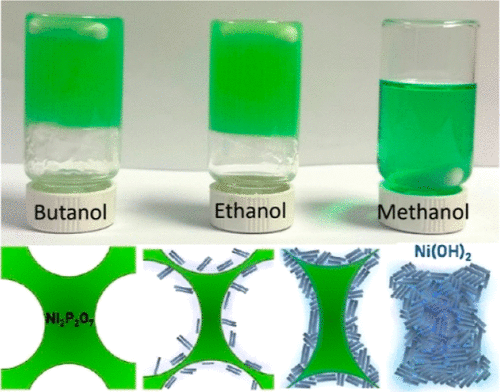
We congratulate our alumni Gözde Ceran, Irmak Karakaya Durukan, and Işıl Ulu for their newest ACS Inorganic Chemistry article “Scalable Solvent-Mediated Nanoarchitectonics of High-Surface-Area Mesoporous Ni2P2O7 for Enhanced Electrochemical Performance in Alkaline Media“!
The article’s abstract as follows:
Sol–gel synthesis provides a versatile and scalable route for producing high-surface-area materials. Here, we develop a facile sol–gel strategy for mesoporous nickel pyrophosphate (Ni2P2O7) using H4P2O7, nickel nitrate, and Pluronic P123 in butanol- and ethanol-based media. These mixtures form homogeneous sols that gelate and, after drying and calcination at 300 °C, yield powders with surface areas up to 410 m2 g–1. In contrast, methanol systems─and certain ethanol conditions─phase-separate into precipitate and supernatant layers. After calcination, the solution and precipitate fractions produce mesoporous Ni2P2O7, while the supernatant fraction forms Ni3(PO4)2 with different textural properties. The materials remain amorphous up to 600 °C and crystallize into α-Ni2P2O7 at 700 °C.
Thin-film electrodes were prepared by spin-coating on fluorine-doped tin oxide and dip-coating on graphite, followed by calcination. In 1 M KOH, Ni2P2O7 converts into ultrafine Ni(OH)2 nanoflakes, with the transformed graphite-supported electrodes showing high oxygen evolution reaction (OER) activity and stability. Moreover, Ni2P2O7 is stable in alkaline media (pH ∼13) when the P2O74– concentration exceeds ∼0.27 M in the electrolyte. This work demonstrates a simple, tunable route to mesoporous Ni2P2O7 and reveals its conversion into highly active OER electrocatalysts (381 mV at 100 mA cm–2, 45 mV dec–1).
1- Inorg. Chem. 2026, 65, 1, 938–951
