There are some articles that delve deep into fundamentals, asking the most basic questions while devising a series of experiments to solve a frequently observed problem. This paper, “Manganese oxide-based mesoporous thin-film electrodes: manganese disproportionation reaction in alkaline media” published in the Journal of Materials Chemistry A, is exactly like that. It discusses observations of manganese oxide-based electrode degradation and explores how manganese disproportionates in alkaline media during the Oxygen Evolution Reaction (OER).
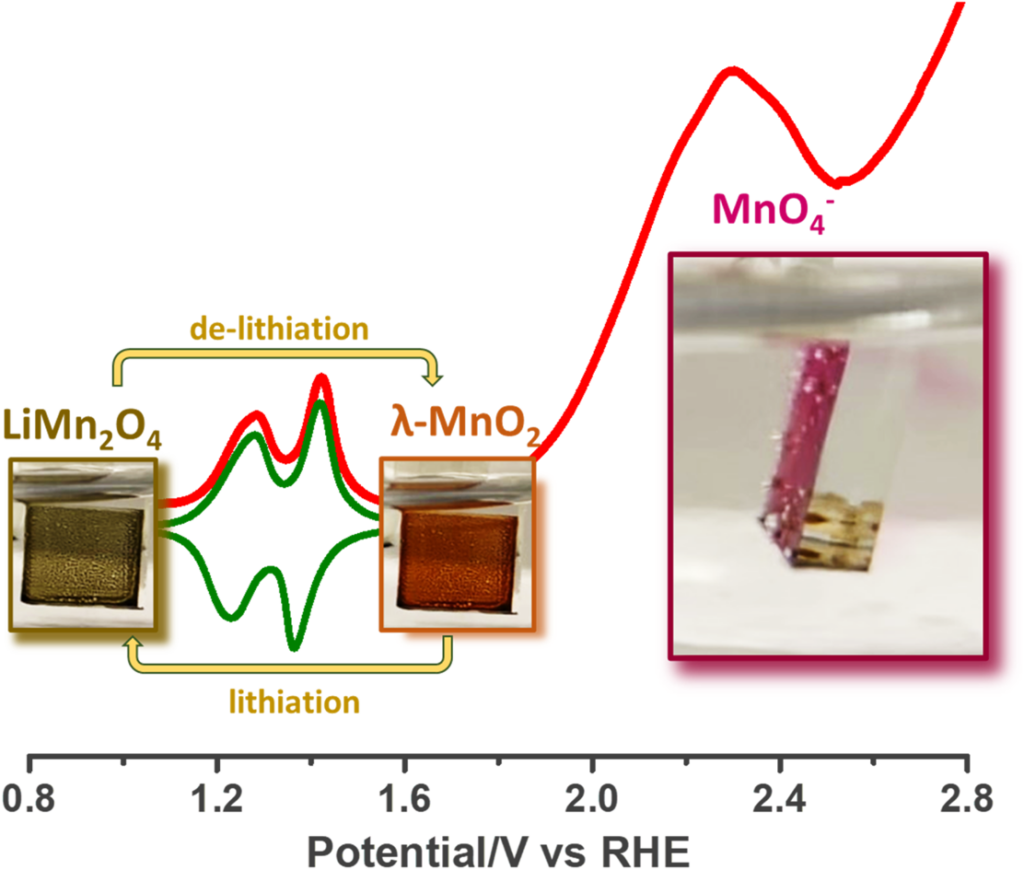
We would not like to spoil the surprise by explaining the entirety of this work, but keep in mind that the oxidation of various manganese-based oxides (LiMn2O4, Mn3O4, and Mn(OH)2) produces different MnO2 polymorphs, each undergoing rapid decomposition. At high electrochemical potentials, it is discussed that three Mn(VI) sites undergo a spontaneous disproportionation reaction to produce Mn(VII) and Mn(IV) surface species. The Mn(VII) product forms permanganate ions, dissolving into the electrolyte with a distinct pink color, whereas the latter precipitates as manganese dioxide (MnO2). Of course, some electrodes, such as lithium manganese oxide (LMO), show much higher stability due to a reversible transformation into λ-MnO2.
This article was also published to honor Professor Geoffrey Ozin’s 80th birthday. We would like to thank our alumni Irmak Karakaya Durukan and Işıl Ulu for their valuable work.