We would like to congratulate our Ph.D. student, Irmak Karakaya Durukan, on her recently published article, “Electronic Synergistic Effects on the Stability and Oxygen Evolution Reaction Efficiency of the Mesoporous LiMn2–xMxO4 (M = Mn, Fe, Co, Ni, and Cu) Electrodes” in the ACS journal Inorganic Chemistry.
The article’s abstract is as follows:
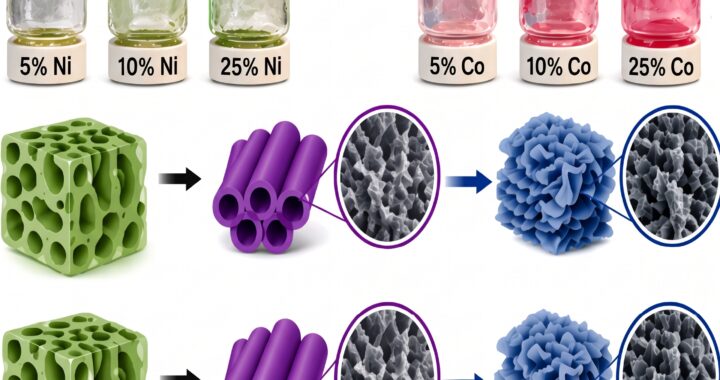
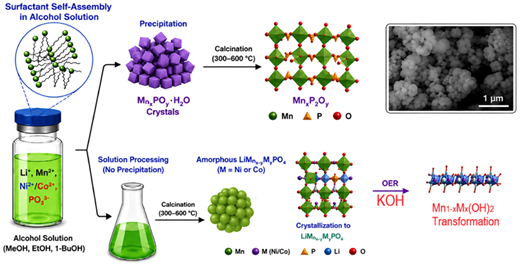
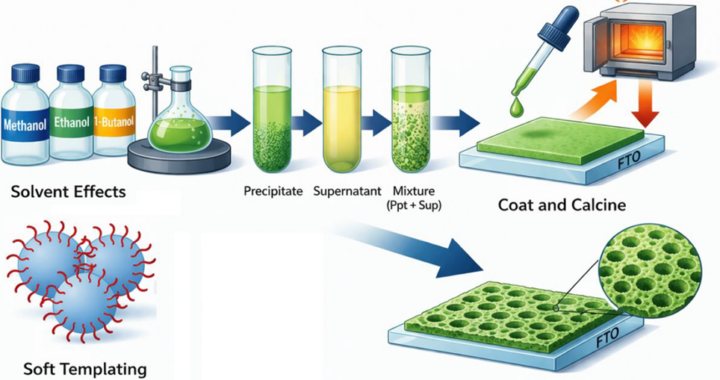
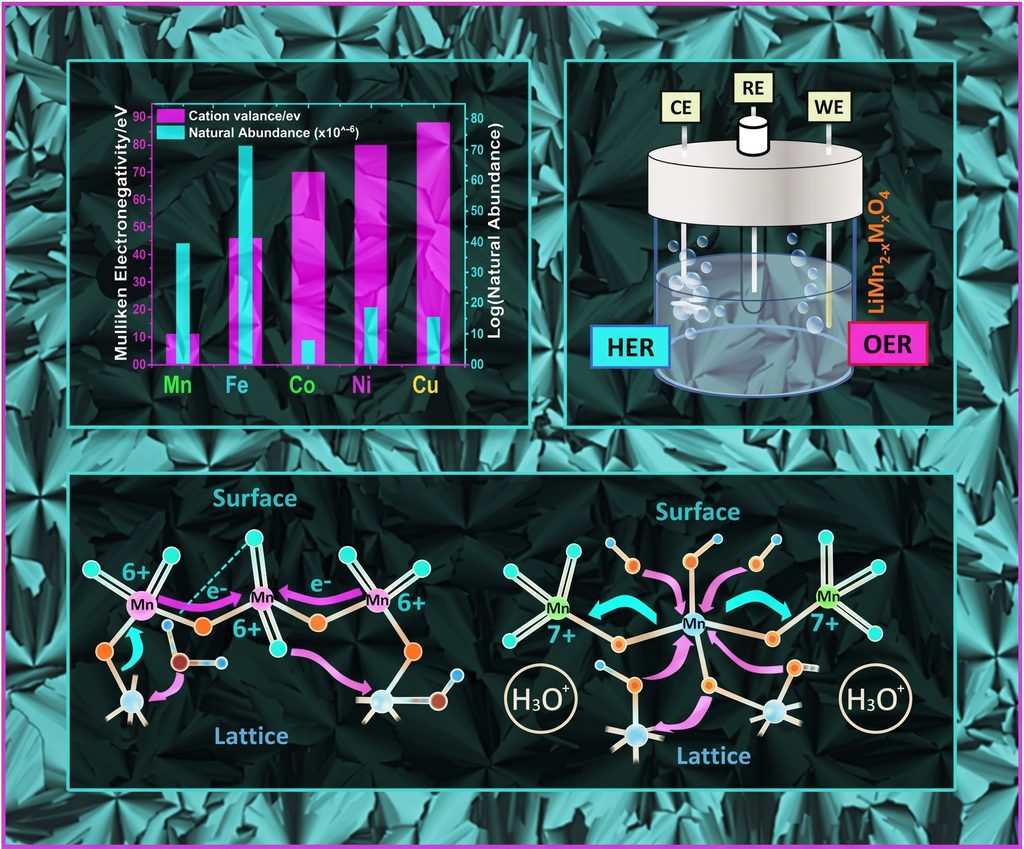
Stable porous manganese oxide-based electrodes are essential for clean energy generation and storage because of their high natural abundance and health safety. This investigation focuses on mesoporous LiMn2–xMxO4 (where M is Fe, Co, Ni, and Cu and x is 0, 0.1, 0.3, 0.5, and 0.67) electrodes and thin/thick films. The mesoporous electrodes and films are fabricated by coating clear and homogeneous ethanol solutions of the salts (LiNO3, [Mn(OH2)4](NO3)2, and [M(OH2)x](NO3)2) and surfactants (P123 and CTAB) and calcining at elevated temperature (denoted as F-LiMn2–xMxO4, G-LiMn2–xMxO4, and meso-LiMn2–xMxO4, respectively). The electrochemical properties, stability, and oxygen evolution reaction (OER) performance of the F/G-LiMn2–xMxO4 electrodes are investigated in alkaline media using a three electrode setup. The F-LiMn1.33M0.67O4 electrodes (where M is Mn, Fe, Co, and Ni) exhibit low Tafel slopes of 60, 43, 44, and 32 mV/dec, respectively. While all the Mn-rich and F-LiMn2–xFexO4 electrodes degrade via Mn(VI) disproportionation reaction, the 33% Co electrode shows high stability during the OER. The nickel-based electrodes are stable with as little as 15% Ni and display excellent OER performance over 25% Ni, albeit undergoing a transformation that accumulates Ni(OH)2 species on the electrode surface. Copper in the F-LiMn2–xCuxO4 electrodes is homogeneous at low Cu percentages but forms a CuO phase above 15% Cu, undergoes degradation, and displays a weak OER performance. In short, Co and Ni stabilize the F-LiMn1.33Co0.67O4 and F-LiMn1.7Ni0.3O4 electrodes, which display excellent OER performance.