We would like to congratulate our Ph.D. student Arda Altan, and our alumni, Irmak Karakaya Durukan, and Işıl Ulu on their recently published article, “Alcohol-Mediated Self-Assembling Nanoarchitectonics of Mesoporous LiMPO4 and M2P2O7 (M = Mn, Co, and Ni) for Alkaline OER via Metal Hydroxide Transformation” in the ACS journal Applied Energy Materials.
The article’s abstract is as follows:
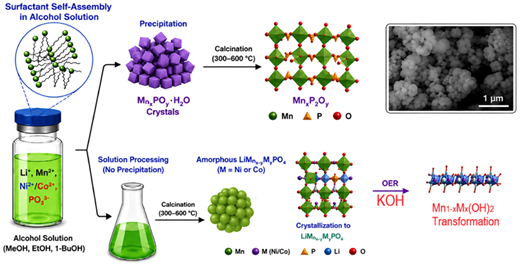
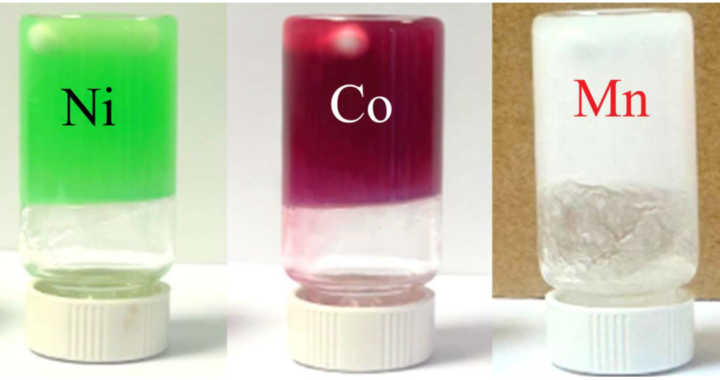
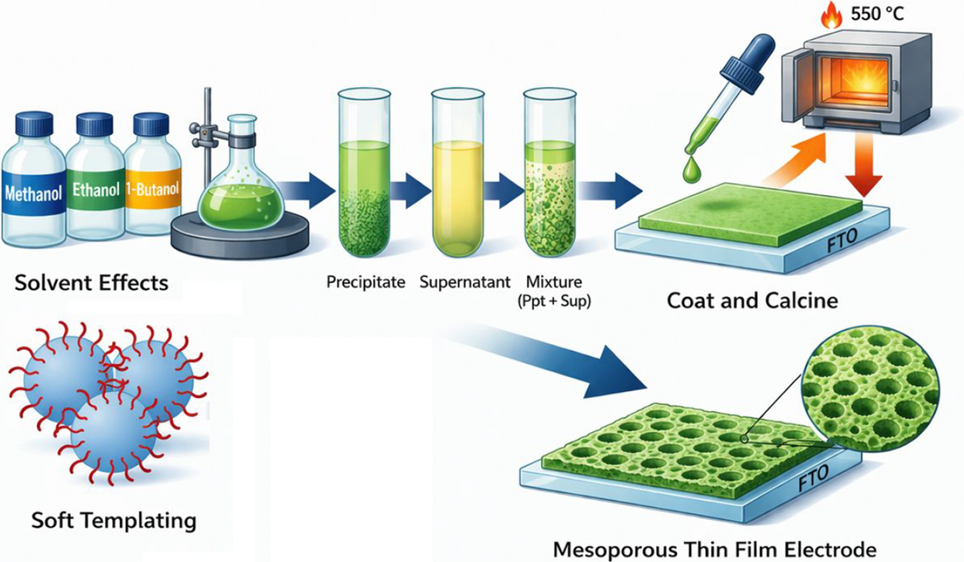
Mesoporous lithium transition-metal phosphates (LiMPO4) and metal pyrophosphates (M2P2O7) are important materials for energy-related applications. Herein, we report an alcohol-mediated surfactant self-assembly strategy for synthesizing these materials using methanol, ethanol, and 1-butanol as solvents and Mn(II), Co(II), and Ni(II) nitrates as metal sources in the presence of Pluronic P123. Clear precursor solutions containing lithium nitrate, transition-metal nitrates, phosphoric acid, and P123 undergo solvent-dependent precipitation and gelation, yielding distinct precipitate, supernatant, and solution fractions, which were investigated separately before and after calcination. Precipitation is most pronounced in 1-butanol and minimal in methanol. Upon calcination (300–700 °C), solution phases yield olivine-type LiMPO4, whereas precipitates are lithium-free, forming MnPO4·H2O (transforms to β-Mn2P2O7 above 400 °C), α-Co2P2O7, or α- and δ-Ni2P2O7 phases. The solution and supernatant fractions were deposited on FTO and graphite substrates and evaluated electrochemically in alkaline media. Under OER conditions, all electrodes transform into their corresponding metal hydroxides, which govern the electrochemical response. Among them, methanol-derived Co- and Ni-based electrodes exhibit superior activity and stability, followed by 1-butanol-derived samples, while ethanol-derived electrodes show the poorest stability during OER.